
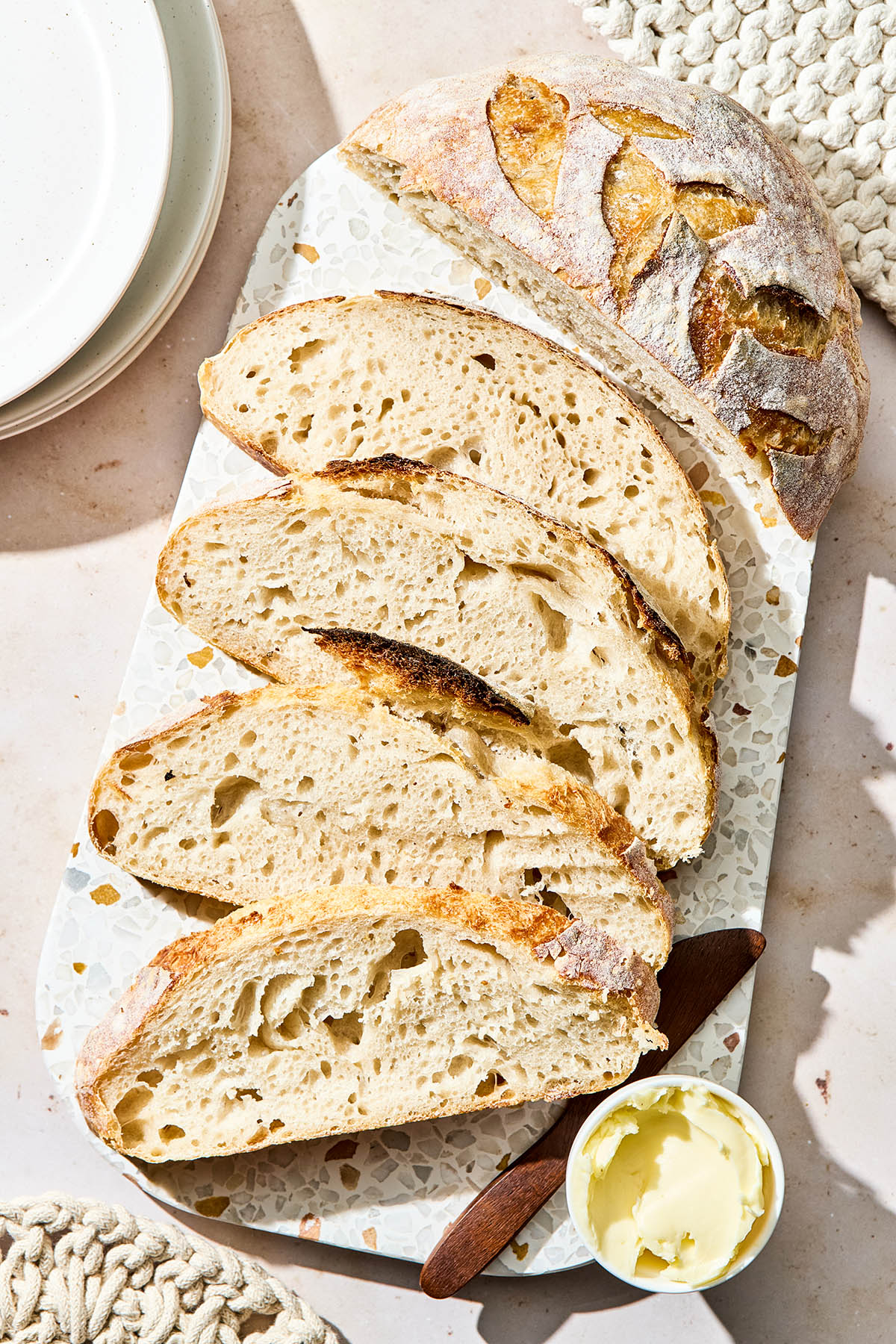
The ideal basic sourdough, this no-knead sourdough bread is ideal for beginners and experienced bakers alike. It's a great weekly bread recipe and can be made with either starter or levain. You don't need special flour for this, just plain all-purpose, and a healthy active starter. See how to make sourdough starter. This recipe is from the Artisan Sourdough Made Simple cookbook and was shared with the permission of the publisher.
Sourdough can be intimidating but it shouldn't be! No-knead sourdough bread is even easier to make than a regular yeast loaf and takes less hands-on time. It's all about being patient and doesn't need special skills or a lot of knowledge (though the more experienced you get, the better your bread will be). We've included loads of information in this post, and across the site, to help you make the best bread possible.
One reader, Claire, commented: "Out of all the sourdough recipes I’ve been trying, this one is the least finicky! Great results each time, too."
Another reader, Annemarie, said this: "I have made this loaf mannnny times since the first loaf (pictured) and it's nearly foolproof. I made a loaf today that bulk proved for 12 hours and it's GORGEOUS!! This recipe is a must-make! Followed the recipe 100%. Ten hour rise, baked in ceramic crock pot insert. This is the most successful sourdough loaf I've had to date!"
Jump to:
Ingredients

Ingredient Notes and Substitutions
- Flour: this recipe calls for strong bread flour, but we quite often use regular all-purpose flour with good results. If you want to add whole wheat flour, it can replace up to 40% of the white flour.
- Starter: you can use either active starter or levain. Using levain will make a slightly milder tasting loaf. Active starter means starter that has been fed and is at its peak when added to the dough.
- Water: depending on where you live, you might prefer to use filtered water rather than tap water. Some bakers say that their local tap water can make for less successful sourdough and there are sometimes additives that can slow down the rise or make the taste a little less pleasant.
- Salt: choose fine grain salt. It doesn't matter if it's sea salt, table, or kosher, as long as it's finely ground.
For more basic sourdough, try making your own sourdough pizza dough. If you don't have a Dutch oven but still want to make naturally risen bread, you can try this sourdough pan loaf instead. For a whole grain recipe make this 100% whole wheat sourdough bread.
Use the JUMP TO RECIPE button at the top, or scroll to the bottom of the post to see the printable recipe card with full ingredient measurements and complete instructions.
Method

Step 1: whisk the starter and water together to combine.
Step 2: mix in the flour and salt to form a shaggy dough.
Step 3: turn the dough onto a surface and let it rest, then shape into a ball by pressing the dough into the middle.
Step 4: place the dough back into a bowl to rise overnight at room temperature.

Step 5: in the morning, shape the dough by stretching and pressing the dough into the middle of the loaf.
Step 6: shape the dough into a boule, then place in a prepared banneton. Cover and rest for about an hour.
Step 7: preheat the oven, then turn out the bread and score it.
Step 8: bake for about an hour in total and cool for at least one hour before slicing.
Top Tips
- Let the loaf rest: the recipe calls for the baked loaf to cool for an hour before slicing. Consider this the bare minimum of cooling time. If your sourdough bread looks like it's pilling when you slice it, let it cool for longer before cutting into the loaf.
- Don't worry about metal: this is a myth, and nothing bad will happen if you mix your starter with a metal spoon or use a stainless steel whisk or bowl. While you shouldn't store starter or mix sourdough bread in a copper bowl, almost all kitchen utensils are made from steel, so it's not an issue.
- Moisture is key: use a damp tea towel to cover the dough and the shaped loaf. We like to pop a plate on over the tea towel, too. A dry towel and nothing else will let too much air in and will dry out the top of the dough, preventing optimal rise.
Recipe Notes
To get the best surface tension, don't add too much flour to your work surface when shaping the dough. Try to move the loaf to a clean part of the counter, sprinkle just the top with some flour to prevent your hands sticking, and shape that way. You need a bit of pull and flour under the dough will prevent that.
We don't provide cup measurements for sourdough recipes because it needs to be exact and volume measurements aren't accurate enough. If you want to make sourdough bread, you will need a kitchen scale. They cost about $10 and will improve your baking like you wouldn't believe.
Baker's Schedule
Thursday–Saturday: Feed your starter until bubbly and active.
Saturday Evening: Make the dough, and let rise overnight.
Sunday Morning: Shape the dough, let rise again, score, and bake.
How to Store
Storage: keep your sourdough bread in a paper bag or wrap the cut end with something like beeswax wrap. See Sophie's full guide on how to store sourdough bread for more.
Freezing: the best way to freeze sourdough is to cut it into slices and freeze in an airtight container. Take individual slices out when needed and thaw them right in the toaster.

All-Purpose vs. Bread Flour
Most sourdough bread recipes will call for strong bread flour. It's a higher gluten flour that's easy to work with and makes very chewy loaves – great, but can be difficult for beginners. If you're in Canada you have access to the strongest bread flour around, same for the US. British and European strong flour is about equivalent to Canadian all-purpose flour.
So if you're in North America, you can get really great loaves using plain white flour and don't need to spend the extra money on bread flour to make excellent sourdough. Most of our sourdough recipes are made with all-purpose flour. If you're in the UK or Europe, this recipe will work with plain white flour, but it will be easier to make with strong flour.
Sourdough Essentials
If baking sourdough bread is new to you, these guides will be helpful in getting started:
How To Make Sourdough Starter From Scratch
Essential Sourdough Tools
How To Stretch And Fold Sourdough
How To Shape Sourdough Boules
Troubleshooting Sourdough Bread
More Sourdough Bread Recipes


If you make this Beginner's Sourdough Bread recipe or any other sourdough bread recipes on the Baked Collective, please take a moment to rate the recipe and leave a comment below. It’s such a help to others who want to try the recipe. For more baking, follow along on Instagram, TikTok, and YouTube.
Sourdough Bread for Beginners
Equipment
- Whisk
- Mixing bowl
- Tea towel
- Bench scraper
- Very sharp knife or lame
- Dutch oven as large as possible
- Wire rack
Ingredients
- 50 grams active sourdough starter
- 350 grams warm water, about skin temperature
- 500 grams bread flour, can use all-purpose flour
- 9 grams fine sea salt
Instructions
Baker's Schedule
- Thursday–Saturday: Feed your starter until bubbly and active.
- Saturday Evening: Make the dough, and let rise overnight.
- Sunday Morning: Shape the dough, let rise again, score, and bake.
Make the Dough
- Whisk the starter and water in a large bowl in the evening.50 grams active sourdough starter, 350 grams warm water
- Add the flour and salt. Combine until a stiff dough forms, then mix by hand to fully incorporate the flour. The dough will feel dense and shaggy and stick to your fingers as you go.500 grams bread flour, 9 grams fine sea salt
- Scrape out as much as you can onto a work surface. Cover with a damp tea towel and let it rest for 30 minutes. Replenish your starter with fresh flour and water and store according to preference.
- After the dough has rested, work it into a smooth ball by grabbing a portion, folding it over, and pressing your fingertips into the center. Repeat, working around the dough until it begins to tighten, about 15 seconds.
Bulk Rise
- Cover the bowl with a damp tea towel and let it rise overnight at room temperature. This will take about 8 to 10 hours at 70°F (21°C). The dough is ready when it no longer looks dense and has doubled in size.
Shape
- In the morning, coax the dough onto a lightly floured work surface. Start at the top and fold the dough toward the center to shape it into a round. Turn the dough slightly and fold over the next section of dough. Repeat until you have come full circle. Flip the dough over and let rest for 5 to 10 minutes.
- Meanwhile, line an 8-inch (20-cm) banneton or bowl with a towel and dust with flour. With floured hands, gently cup the dough and pull it toward you in a circular motion to tighten its shape. Use a bench scraper to scoop the dough into the bowl, seam side up. See how to shape sourdough boules.
Second Rise
- Cover the bowl and let rest for 30 minutes to 1 hour. The dough is ready when it looks puffy and has risen slightly but has not yet doubled in size.
- Preheat your oven to 450°F (230°C).
- Cut a sheet of parchment paper to the size of your baking pot (or Dutch oven), leaving enough excess around the sides to remove the bread.
Score
- Place the parchment over the dough and invert the bowl to release.
- Sprinkle the dough with flour and gently rub the surface with your hands.
- Using the tip of a small, serrated knife or a razor blade, score the dough with a cross-cut pattern or any other pattern you like.
- Use the parchment to transfer the dough to the baking pot.
Bake
- Bake the dough on the center rack for 20 minutes, covered. Remove the lid, and continue to bake for 30 minutes. Carefully remove the loaf from the pot and bake it directly on the oven rack for 10 minutes to crisp the crust. When finished, transfer to a wire rack. Cool for 1 hour before slicing.
- Sourdough is best on the same day it is baked. See how to store sourdough bread.
Notes
Nutrition
Nutrition information is an estimate and is provided as a courtesy. For precise nutritional data, please calculate it independently using your preferred nutrition calculator.
This post may contain affiliate links. If you purchase through these links, we may earn a small commission, at no additional cost to you.
 Did you make this recipe?Please consider leaving us a rating and a comment. It helps others find our work, which genuinely supports what we do. Thank you!
Hello! Is there a way to get the recipe back that had the stretch and folds in it? I loved that recipe. Thank you!
Hi Sigourney, I'm going to have a newly written post up with that recipe on Monday. In the meantime, I've emailed you a copy!
Your everyday no-knead sourdough recipe on the previous blog was my OG loaf that I ever got to work and I shared it with many people. This recipe is similar, but the original one didn't have stretch and folds (which I preferred as a beginner and for sharing with beginners). It was my favorite precise but simple recipe that always churned out great bread. Is that another recipe that you don't own and can't transfer? 🥺 the video on that page was so simple and helpful and I had that recipe by memory but I know there were so many helpful details that I'd like to impart to a new-to-sourdough friend.
Hi Sarah, the recipe has now been updated with that recipe.
Hi Alex, I agree with Sarah. That recipe along with your wonderful video was my go to ever since I started making sourdough bread during the pandemic. I miss the video so much. I understand that you can’t republish the recipe so I will get the book, but is your video available anywhere?
Your New York Style Sourdough Bagel Recipe is the best! Unfortunately your page seems to be broken on that link and my daughter is begging me to make them. Could you forward it to me please. Thank you so much.
Hi there, here's the sourdough bagel recipe.